

Agency mortgage-backed securities (MBS) can play a valuable role within the investment tranche of reserve portfolios, complementing core sovereign holdings by providing incremental yield without introducing traditional credit-cycle exposure. Against today's backdrop of higher interest rates and subdued mortgage refinancing, the income-to-risk profile of agency MBS has improved, making the asset class increasingly attractive for reserve managers seeking diversification and liquidity characteristics comparable to US Treasuries.
Unlike sovereign bonds, agency MBS returns are driven by mortgage borrowers' prepayment behavior and the resulting convexity, which influence cash flows, duration and reinvestment risk. Effective portfolio construction therefore depends on relative value analysis supported by loan-level research, prepayment modeling and scenario analysis.
Replicating the agency MBS benchmark is far more complex than replicating a Treasury index. As of June 30, 2026, the Bloomberg US Intermediate Treasury Index comprised 199 individual Treasury securities, while the Bloomberg US MBS Index consisted of 1,101 representative cohorts grouped by issuer, maturity, coupon, vintage and collateral characteristics. These cohorts are not directly tradable and are backed by thousands of individual mortgage pools, making passive replication challenging.1
The MBS investable universe extends well beyond the benchmark, encompassing more than one million agency securities, including TBA securities, collateralized mortgage obligations (CMOs) and agency commercial MBS (CMBS). Active managers can selectively allocate across these sectors, coupons and collateral characteristics to capture relative value opportunities while maintaining liquidity and managing portfolio risk in line with the benchmark.
Within the benchmark itself, active positioning across conventional 30-, 20- and 15-year MBS, as well as GNMA versus conventional mortgages, has historically provided opportunities to enhance portfolio outcomes while remaining invested in the market's most liquid sectors.
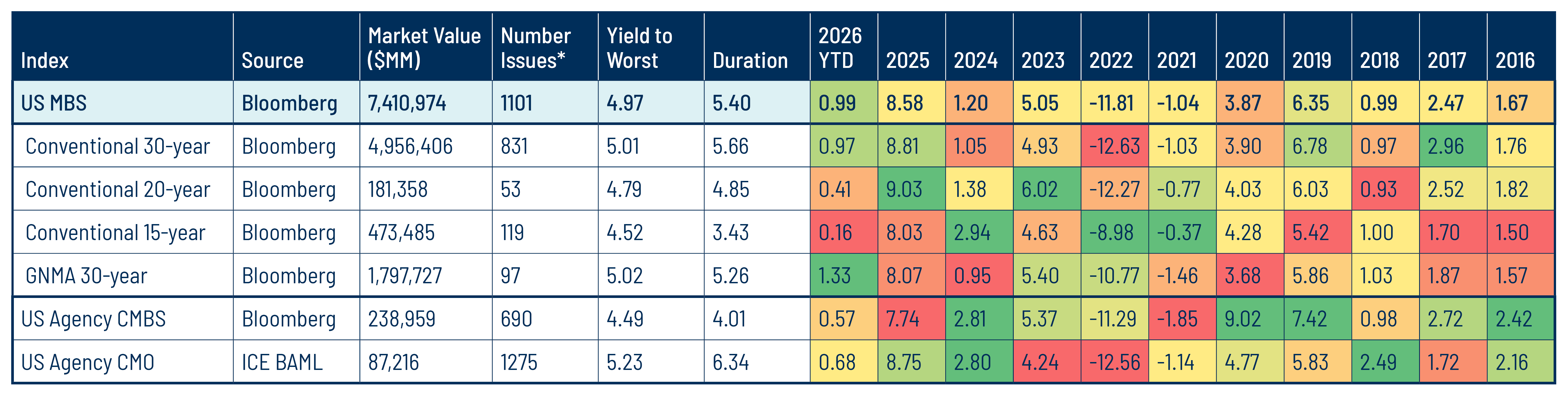
Agency CMBS and agency CMOs, while excluded from the benchmark, can further broaden portfolio opportunity sets. For reserve portfolios, these allocations should be used selectively, where long-term fundamental value and portfolio diversification justify the additional complexity.
Agency CMBS are primarily backed by multifamily housing and health care loans that incorporate strong prepayment protections, including lockout periods, yield maintenance or prepayment penalties. These structural features reduce cash-flow uncertainty and provide diversification relative to agency residential MBS (RMBS), particularly during periods of elevated refinancing activity such as 2020.
Agency CMOs redistribute cash flows from mortgage pools into tranches with distinct duration, yield and convexity characteristics. Structures range from sequential-pay and planned amortization class (PAC) securities to interest-only (IO), principal-only (PO) and floating-rate tranches. During periods of elevated rate volatility or monetary tightening, selective allocations to floating-rate CMOs may help reduce extension risk and moderate portfolio interest-rate exposure.
Within pass-through allocations, active coupon positioning represents another important source of excess return. The conventional 30-year market currently spans 12 coupon levels, with similar coupon stacks across GNMA, 15-year and 20-year sectors. Tactical positioning across premium and discount coupons—informed by duration, yield, moneyness (underlying weighted average mortgage rate/the prevailing mortgage rate) and collateral characteristics—can enhance risk-adjusted returns relative to benchmark allocations.
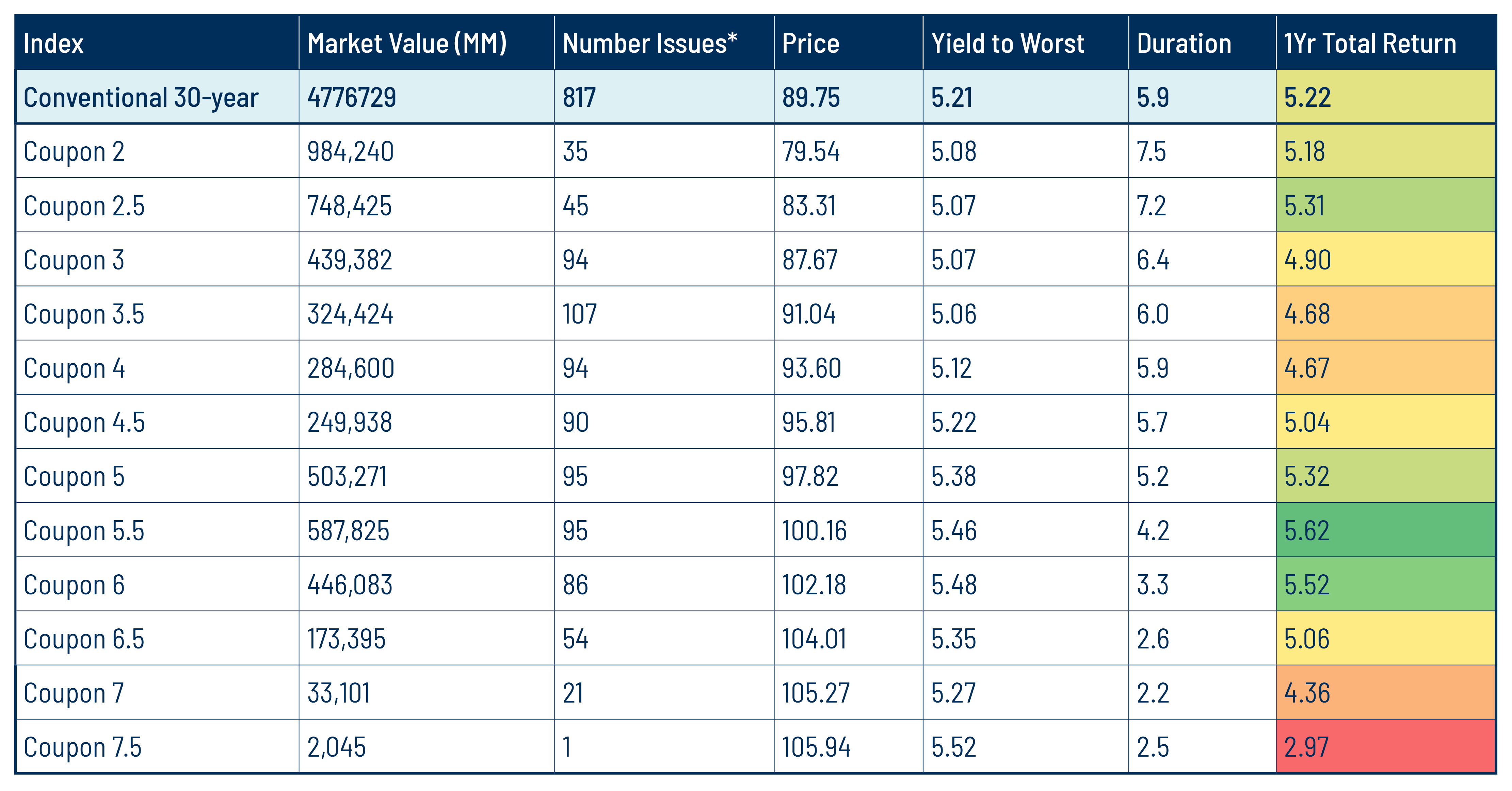
Security selection remains the foundation of active management. Western Asset's investment process combines macroeconomic views and cross-sector relative value with detailed mortgage loan-level analysis, including factors such as loan size, seasoning, servicers, borrower credit characteristics and loan-to-value ratios. For example, lower loan size pools like 200K-max pools (which limit loan sizes to a maximum of $200,000) have historically exhibited more favorable prepayments compared to generic collateral of the same coupon, contributing to stronger relative performance as discounts or as premiums. Active management within agency MBS can mostly mitigate risks by emphasizing top-down macro themes and bottom-up loan level research in portfolio construction.
The breadth and structural complexity of the agency MBS market create opportunities that extend well beyond benchmark replication. For reserve managers, disciplined active management—grounded in rigorous relative value analysis, security selection and prudent risk management—may be able to enhance portfolio resilience while preserving the liquidity and high credit quality, which make agency MBS appealing as a core reserve asset.
Capturing these opportunities, however, requires more than investment expertise. Institutional agency MBS investing also depends on sophisticated risk systems, efficient trade execution and robust mortgage cash-flow management. In our next post, we will examine how these operational capabilities support effective agency MBS portfolio management.
ENDNOTES
1. Source: Bloomberg. As of June 30, 2026.